Showing posts with label Gawadar. Show all posts

Thursday, January 26, 2017

Future of China Pakistan Economic Corridor


Future of China Pakistan Economic Corridor


If the China Pakistan Economic Corridor (CPEC) wasn’t already an enigma, the recent debates regarding its pros and cons have muddled this into an even bigger mess. On one hand, there are the knockers who didn’t shy away from labelling it as the future East India Company (EIC), and on the other, we have the blind patriots – the ones that hold CPEC at the highest level of sanctity, that merely questioning the transparency regarding CPEC’s projects amounts to treason for them.

Undoubtedly, these directionless debates have a lot to do with the suspicion and political sensitivity created by the government around the CPEC framework. However, to me, both prevalent views are far-fetched and perilous to national interests.

At first, to equate China’s role, within the context of the CPEC project, with that of EIC is simply an embellishment. Such an over-statement has been countered by various writers in recent days, rather successfully. And quiet evidently, a strict comparison of both is fallacious and misplaced for the simple reason that the days of claiming ‘EIC is like colonialism’ are long gone. Since Pakistan was in a weak state, China’s investment should have been welcomed. China already has deep pockets, thus one should not expect the country to take anything away from us, the way the EIC robbed the subcontinent of its resources.


However, the EIC analogy cannot be completely disregarded. The days of colonialism might be past us, yet, states no longer employ the weapons of the colonial era to subjugate other states, as capitalism now does it for them. In the words of Kwame Nkrumah,


“Capitalism is but the gentlemen’s way of slavery.”

For a state to thrive in this era of capitalism, its financial independence is integral. When a state is financially dependent on another, the way our country was on Saudi Arabia and the United States, that is when a phenomena like that of the EIC in the subcontinent occurs.

Nevertheless, it is the second view that seems more precarious. Nonsensical patriots, who are trying to make CPEC a sacred cow, are forgetting that it is not China’s gift via the Pakistan Muslim League-Nawaz (PML-N) government to the people of Pakistan. If that were the case, then there would be nothing to ponder over. But to our dismay, most of the projects under CPEC are loans which we, the public exchequer, will have to pay back. Unfortunately, the mysterious CPEC framework agreement has not been revealed yet, thereby, we do not know about the terms and conditions encircling the proposed $51 billion investment. In the words of the Governor of the State Bank of Pakistan,


“I don’t know out of $46 billion [in CPEC deals] how much is debt, how much is in equity, and how much is in kind.”

Thus, turning a blind eye to the whole thing is not patriotism, but on a very conservative scale, it is imprudence.

Both the views advanced in the CPEC debate have been poles apart. Ignoring the fact that we as a nation are currently facing a paradox – where on one hand, there is the necessity for such an extravagant investment in our country and on the other, the fear of subjugation at the expense of such an investment.

The antidote for this problem lies with the government, who is primarily responsible for the smooth and uncontroversial functioning of the corridor projects. Unfortunately, the PML-N government has made this matter more ambiguous by building a smokescreen around the CPEC framework agreement. Secondly, and more recently, the ignorance towards Public Procurement Rules in CPEC projects means that the impetus for speculations has been renewed. There is an inherent need for the government to step up and put an end to all the speculations by implying transparency in the CPEC projects.

It is unfortunate that the Sino-Pak friendship is being questioned at a time where a collaboration between the two friendly states is at an unprecedented high – the reason being the lack of transparency around this collaboration. Thus, an onus also lies on the Chinese counterparts as well; they must realise that giving loans through backdoor channels won’t help their cause. For the success of their ‘One Belt One Road’ plan, of which CPEC is an integral part, they need to make sure that the people of Pakistan are engaged and given a sense of ownership in the corridor. The US-Pakistan relationship must serve as a lesson to be learnt – despite the fact that the US injected billions of dollars into Pakistan over the last decade, they were still disliked as a country.

For now, as a nation, we have to redeem ourselves from this state of disunity and realise that by labelling CPEC as a form of colonialism, or making it contentious, might dissuade our foreign investors. Similarly, turning a blind eye to accountability would mean renting Pakistan out on the terms and conditions of investors. Therefore, positive criticism and calculated pressure must be exerted on the authorities to ensure that we are provided with the chance to utilise our strategic location. Firstly, to warrant a profit out of the loans we are availing, and secondly, to result in economic prosperity rather than a burden of unpayable debts.


Source: The Express Tribune

Tuesday, January 3, 2017

Why Astola Island is a hidden gem of Pakistan

Everyone is familiar with the beauty of Pakistan’s northern areas, but few have taken the time to discover the mesmerising charm of the country’s coast in the south.
I had never thought of exploring the coast either, until I met the famous British adventurer Tracy Curtin-Taylor who told me that she had never witnessed a coastline this beautiful.
I planned a trip with my friends to Astola Island, one of the many hidden gems of the part of the Arabian Sea that touches Balochistan.
We set off on our journey on a cool, November morning on a boat from Pasni, a fishing town 35km away from Astola. As we sailed and gained some distance, I looked back at the town: the Jabl-e-Zareen (Beautiful Mountain) was overlooking the pristine beach and the small buildings surrounded by golden sand dunes resembled something straight out of the Arabian Nights.
The golden sand dunes of Pasni in the distance as we were on our way to Astola.
The boat captain told us that the sea is calm during the winter season, making it the perfect time to visit the island.
Once we were in the open sea, we were welcomed by seagulls calmly flying above our heads and a fishing boat nearby, where a man was pulling up his net. The seagulls were silently observing, waiting for the right moment to dive in and steal a fish or two. A few of them succeeded, and it was exciting to see.
As we sailed further ahead, I saw larger fishing boats passing by. My friend Bakhshi, who works at the fishery department, told us that these boats are called “launches”.
Each boat is operated by a team of 15 to 20 men, who catch fish the whole day. The fish caught on the shores of Pasni is famous and is also exported.
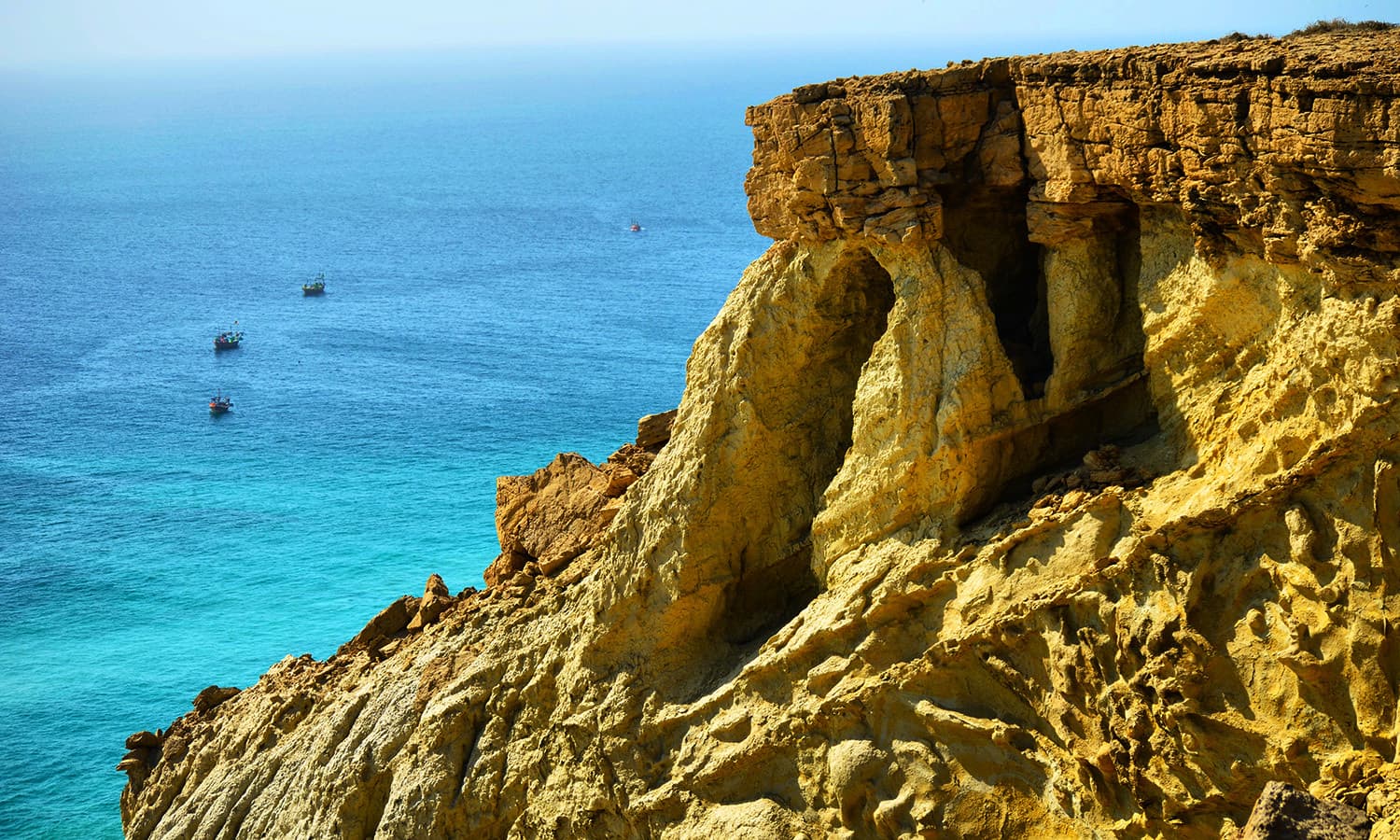
As we neared Astola, my first sight of the island was of a tall, oddly-shaped rock standing in the middle of the sea. But as we inched closer, the crystal clear, turquoise water took my breath away and I had to remind myself that I was still in Pakistan and not at a beach on the Mediterranean.
A stunning range of blues as seen from the hills of Astola.
Astola is also known as Jezira Haft Talar (Island of the Seven Hills) because of the small, rocky mountains that stretch across the 15sq km island.
The reason why the island’s exquisite beauty has remained untarnished is because of its remote location. From Karachi, it is a seven-hour drive to reach Pasni, from where you have to take a three-hour boat ride to Astola.
Once we reached the island, I wanted to see it from a height and so I hiked up one of the hills. The climb was tricky since the mud was soft and the rocks slippery.
After some struggle, I found a well-treaded path. The view was worth it when we reached the top as the island and its shores were even more alluring from above.
It was a thrilling experience climbing up and seeing this amazing view.
The colour of the water and pattern of the beach changes throughout the day depending upon the tide. The seabed is visible to about the depth of 20 feet .
There is no standing structure on the island except for the remnants of a lighthouse the government had built in 1983.
After a few hours on the hills, we climbed down and got on the boat to explore the other sides of the island. I found every side of the island to be different and more beautiful than the other. The southern side did not have a beach.
We went snorkeling and it was startling to see so many multi-coloured fish. When we went back on the boat, the fishermen showed us some of the fish they had just caught.
The fish that the fishermen on our boat caught while we were snorkelling.
Since there are no facilities on the island, we had to pack everything from water, food, to camping supplies. We had lunch on our boat with jellyfish swimming around with their tentacles floating behind them.
One of my friends got stung and was in pain for the next 10 hours. People who are visiting for the first time should be aware that jellyfish only look pretty.
Vegetation on the island is sparse and consists of shrubs and large bushes that come to life when it rains. The island has no source of fresh water of its own. Keekar is the only tree which can survive the harsh conditions.
Astola is a tough yet popular destination for camping and eco-tourism. People usually set up camp at the beach and go snorkeling, deep sea diving and even hunt fish under water.
As Astola receives more recognition, the number of tourists will increase. Let’s hope that this doesn’t damage the island’s beauty.
It felt calm and peaceful by the sea in the afternoon.
The sunset was breathtaking from the seven hills of the island.
One of the boats of campers visiting Astola island.
Fishermen throw in their nets in the sea.
A view of the island from our boat.
The climb up the hill was worth the struggle; the bird's eye view of the island was beautiful.
There is limited greenery and vegetation on the island.
The strange rock formations I saw as we reached Astola.
The crystal clear, turquoise water appeared to be a darker colour from a distance.
The beach on the island is incredibly clean, unlike other parts of Pakistan.
We had to bring our own supplies and cook our own food while camping on the island.
There were many seagulls hovering closely above us in search of fish as we were on our way.
The hills were of many different shapes, each of them unique.
A picturesque view from the hill we climbed, with fishing boats in the distance.
The reflection on the water of the golden sunlight in the evening was beautiful.
There were many different seashells scattered on the beach.
The magnificent sunset on the beach.

Source: www.Dawn.com

Monday, November 14, 2016

Moonis Elahi Says CPEC Completed Due to Gen Raheel Sharif's Efforts

Moonis Elahi Says CPEC Completed Due to Gen Raheel Sharif's Efforts


Gawadar received its first Chinese convoy on 12 Nov 2016. Moonis Elahi congratulated the people of Balochistan as the army led CPEC will surely bring prosperity in the province that has long suffered ignorance. Opening an international trade route always benefits the people of the region economically and socially. 

India tried to sabotage the project through various antics but has failed in its evil plans.
Pakistan on the whole will reap its rewards and Gen Raheel Shareef will be remembered as the cwho has helped Pakistan establish an international trade route with its closest ally China. Moonis Elahi says even the incumbent government acknowledges it was not capable to have completed the project had the army not helped.